
By the time a scented home and personal care range reaches the signature stage, the scent has been chosen, the pack has been designed and the calendar has been agreed. The remaining questions look administrative, and that is exactly why they are worth asking now: they determine whether the second order is routine, whether the product can move if the relationship changes, and who carries the cost when a deadline slips. Nobody enjoys this part of a project, and the brands that handle it quickly are the ones that arrive with a written question list rather than a feeling that something should be checked.
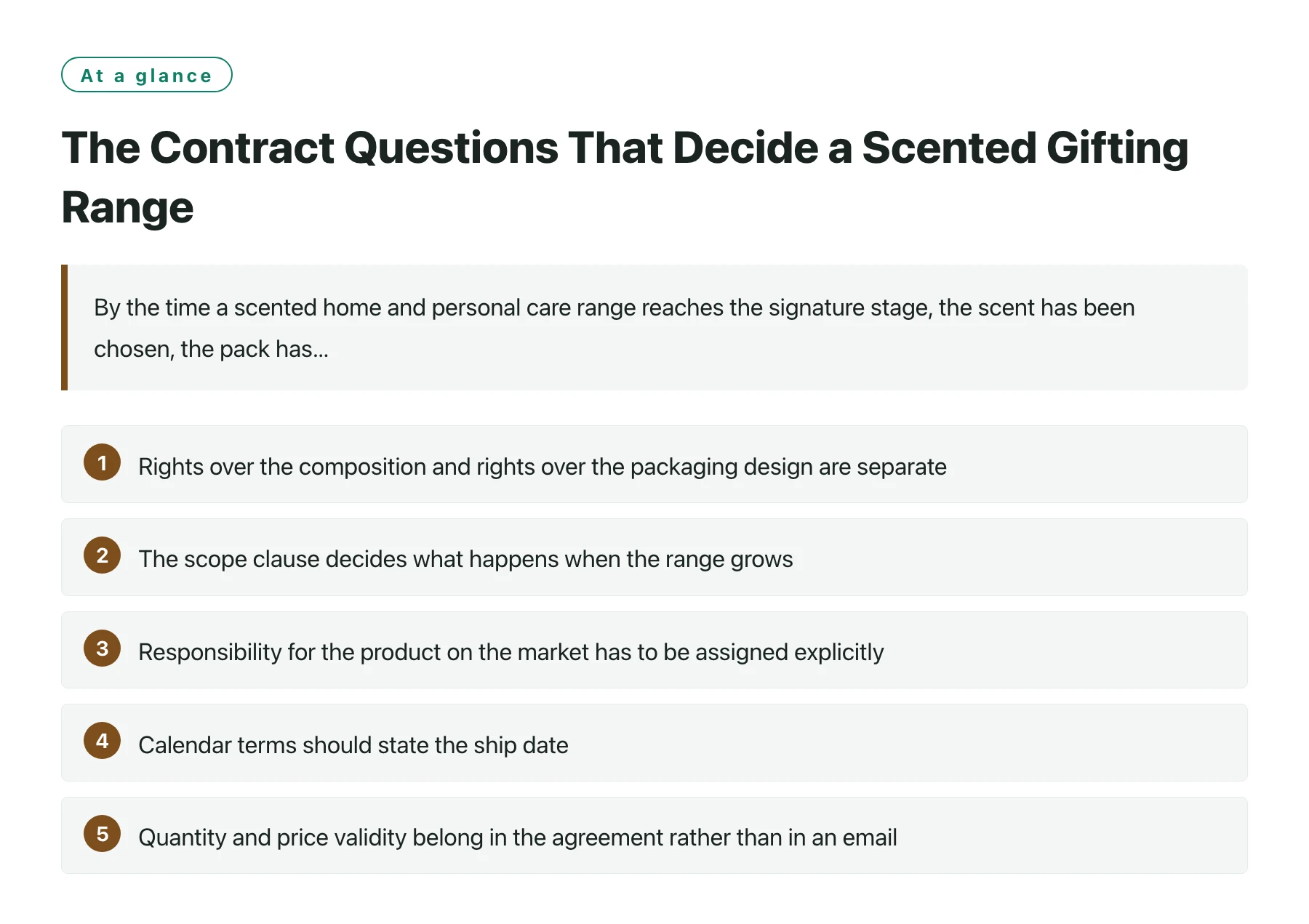
Key takeawaysRights over the composition and rights over the packaging design are separate, and both should be settled before signing because each protects a different asset [1]. · The scope clause decides what happens when the range grows, so it should name which formats, which decoration methods and which services are included in the agreed price. · Responsibility for the product on the market has to be assigned explicitly, because in many jurisdictions the brand placing a cosmetic product on the market carries that role [2]. · Calendar terms should state the ship date, the freight assumption and the consequences of a delay, including which party bears the cost. · Quantity and price validity belong in the agreement rather than in an email, because a festive range is usually reordered and the second conversation should be shorter than the first. · Handover terms should list the documents and artefacts the brand receives at completion, which is what makes the product portable later.
Contract conversations in fragrance manufacturing tend to focus on price and delivery, because those are the numbers both sides can see. The clauses that cause difficulty later are usually the ones nobody proposed discussing: what counts as included scope, who owns the artwork, what happens if a market requirement changes, and what the brand receives at the end.
For a range covering home and personal care products, the questions multiply slightly because the items in one box may follow different rules. That is an argument for asking the questions in a structured way rather than relying on the agreement template, which was probably written for a single product type.
This is a procurement question set organised by what each question protects, written for a festive gifting range where the agreement has to serve the first order and the reorders that follow.
The question set, grouped by what it protects
| Question | What it protects | A clear answer names |
|---|---|---|
| What exactly is included in the agreed scope? | The price, when the range grows | The formats, decoration methods, filling, assembly and documentation included, plus an exclusions list |
| Who owns the formula, and what rights does the brand receive? | The ability to reorder and to move production later [1] | Use rights, exclusivity field and territory, duration, and treatment at termination |
| Who owns the artwork, drawings and dielines? | The packaging asset, which is often the most visible part of the product | Ownership or licence terms for artwork and tooling, and where files are held |
| Who is responsible for the product on the market? | The legal position in each destination market [2] | The responsible entity per market, and which party supplies the documentation |
| What is the ship date, and what is the freight assumption behind it? | The season, and the cost of protecting it | A date, a mode, an incoterm, and the consequence of a delay |
| What triggers a price change? | Budget certainty across the order and its reorder | The validity period, the index or material conditions that can reopen price, and the notice required |
| What quantities can be ordered, and at what increments? | The reorder path, which is where a seasonal range earns its money | Minimum quantity, reorder increments and lead time for a repeat order |
| What does the brand receive at handover? | Portability of the product if the relationship changes | Specifications with versions, test reports, retained reference, artwork files, labelling inputs |
Eight questions, most of which can be answered in one sitting. The reason to put them in writing is not distrust; it is that a gifting range involves several people on both sides, runs for months, and produces a product that will be made again. Clauses agreed in twenty minutes at the start are what make the second and third order uneventful.
The clauses worth a second look
Two clauses deserve more attention than the rest because they are the ones most often left generic. The first is the scope clause, which in practice defines the price. If the scope says fragrances and excludes packaging, decoration or gift assembly, then every visual element in a gifting range sits outside the agreed figure, which is precisely where a seasonal budget goes wrong.
The second is the rights clause. It is common for a manufacturer to retain ownership of a composition while granting the brand use rights, sometimes exclusively in a field and territory. That arrangement can be perfectly workable. What is not workable is leaving the question unresolved, because a reorder is where it becomes material and a change of supplier is where it becomes expensive.
Questions about the second order, asked on the first
A festive gifting range is designed to be bought again, so the second order should be discussed while the first is being negotiated. The questions that matter are simple: what is the minimum repeat quantity, how long is the agreed price valid, how long does a repeat take once the specification is frozen, and does the retained reference remain available. A supplier that treats those as natural questions has a working reorder process.
It is also worth asking what happens if a component is discontinued. Packaging components change more often than brands expect, and an agreement that says nothing about substitution leaves the brand exposed to a redesign at the least convenient time.
Questions that protect the calendar
Delivery terms in a seasonal range are not just logistics language; they allocate risk. The agreement should state the ship date, the transport mode, the point at which risk transfers, and what happens if the date is missed for reasons inside the manufacturer's control. It is reasonable to ask for a specific remedy rather than a general commitment, and equally reasonable for a manufacturer to ask for a defined approval deadline in return.
The approval deadline is the clause most often missing. A schedule depends on the brand returning decisions within a stated number of days, and an agreement that names that obligation is describing a shared calendar rather than a promise from one side.
Questions about documentation and who holds what
The final group of questions concerns the paper that follows the product. Which specifications, test reports and labelling inputs will the brand receive, in whose name are they issued, and where is the retained reference held. In most markets responsibility for a cosmetic product sits with the entity placing it on the market, which is generally the brand, and the agreement should reflect that division of labour clearly [2].
It is also worth checking a supplier's public record at this stage, since certification and history claims are easy to state and straightforward to document. Reading its background and certifications alongside the contract text is a reasonable final check before signing, and the same instinct applies when comparing contract terms with a partner that describes itself as a contract perfume manufacturing in China provider, because the terms rather than the label are what will be relied on if something goes wrong. A supplier such as Xuelei fragrance manufacturer that is accustomed to documenting its scope and its certifications will generally produce those answers without being pressed for them.
If time is short, protect four clauses and accept standard terms elsewhere: the scope with its exclusions, the rights over the composition and the artwork, the responsibility for each destination market, and the calendar with its approval deadline. Those four decide whether the project can finish without renegotiating, whether the product can be reordered, and whether it can be defended in the market it is sold in. Everything else, including payment staging and packaging details, is comparatively simple to adjust later.
Sources
- WIPO — World Intellectual Property Organization —— The UN agency for intellectual property; resources on industrial design and patent protection relevant to product and packaging design.
- European Commission: Cosmetics in the EU —— The European Commission's overview of EU cosmetics rules, including the responsible person, product information file and safety report requirements.
Frequently asked questions
Does a brand need to own the formula to reorder safely?
Not necessarily, provided the use rights are clearly defined, exclusive in the field the brand operates in, and durable beyond the initial order. Ownership and use rights are separate questions, and the practical test is whether the brand could continue producing the scent under the agreed terms if the relationship changed.
What should the scope clause include for a gifting range?
The formats covered, the decoration methods, filling, gift assembly, documentation and testing. Exclusions matter as much as inclusions, because a gift range has more visual and assembly steps than a standard line, and those are the steps most often assumed to be included.
Who is responsible for compliance in the destination market?
In many jurisdictions the entity placing the product on the market carries the responsibility, which is usually the brand. The manufacturer typically supplies the technical documentation. The agreement should state this division explicitly rather than leaving it to be inferred from the label.
How long should a price be valid for a seasonal range?
Long enough to cover the first order and the likely reorder window, with a stated mechanism if material costs move beyond an agreed threshold. A price with no validity period and no change mechanism is not a firm price, it is an opening position.
What documents should be listed as deliverables at handover?
Version-controlled specifications, test reports, the retained reference from the approved batch, artwork and dieline files, and the labelling inputs derived from the formula. Listing them in the agreement turns a handover into a checklist rather than a request.